
The Veto System
8 min read
Overview
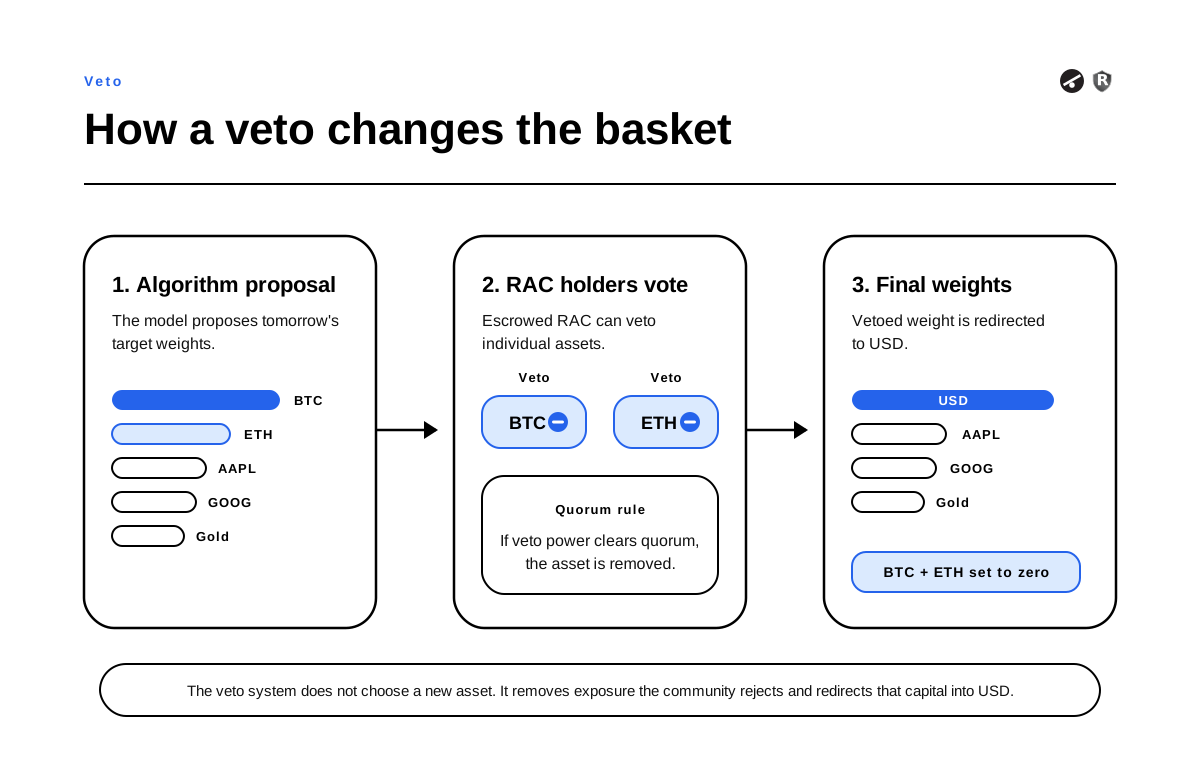
RAC combines algorithmic portfolio construction with a human veto layer.
The algorithm proposes the portfolio. The veto system exists to handle the kinds of risks data alone does not capture well: tail events, regime shifts, governance shocks, exploits, liquidity failures, and other black swan scenarios.
This is not open-ended governance over the entire fund. It is a narrowly scoped, incentive-aligned mechanism for saying:
“This asset should not be in tomorrow’s basket.”
Why Veto Exists
Modern portfolio construction works best when return distributions are relatively stable and covariance estimates remain useful.
Crypto markets are not always like that.
In practice, markets experience:
- abrupt narrative shifts
- exchange failures
- protocol exploits
- regulatory shocks
- liquidity collapses
- non-linear contagion events
These are exactly the moments where historical correlations and volatility estimates are least reliable.
RAC’s veto system is designed to add human judgment where pure quantitative methods are weakest.
Design Principle
The veto system serves one master:
RAC holders.
Every incentive in the system is designed around protecting the value of RAC, not maximizing governance participation for its own sake.
That leads to a simple structure:
- the algorithm proposes weights
- humans can veto individual assets
- vetoes only succeed if enough escrowed RAC voting power agrees
- successful vetoes remove the asset from the next basket
- the removed weight is reallocated to USDC
- voters are rewarded for correct vetoes and penalized for incorrect ones
High-Level Flow
1. The algorithm proposes a new basket
For each rebalance window, RAC produces a proposed weight vector across the eligible asset universe.
2. A voting window opens
RAC holders who have escrowed tokens in the Veto contract can vote during the active window.
Votes are:
- on-chain
- public
- time-bounded
- veto-only
Voters do not suggest replacement assets or custom weights. They can only vote “no” on specific assets.
3. Each asset is evaluated independently
Every asset has its own veto vote.
If enough voting power vetoes a given asset, that asset fails quorum and is removed from the next rebalance.
4. Vetoed weight moves to USDC
When an asset is vetoed, its weight is set to zero and the freed weight is reassigned to USDC.
This preserves full normalization of the portfolio while giving RAC a defensive destination for capital.
5. The final weights are passed for execution
Once the voting window closes, the Veto contract finalizes the weight vector and passes it to RAC for execution.
The veto system determines the final basket. The RAC contract handles trade execution.
Quorum
A veto only succeeds if the total voting power against an asset reaches quorum.
Importantly, quorum is measured against total escrowed voting power, not total RAC supply.
That means governance is determined by active, committed participants, not passive holders.
In simplified form:
- if veto power on asset
iis greater than or equal toq × total_escrowed_voting_power, the asset is removed - otherwise, the proposed weight remains unchanged
This prevents inactive supply from diluting active governance.
Escrow and Voting Power
Voting power is proportional to the amount of RAC a user has escrowed in the Veto contract.
A user can escrow any fraction of their RAC holdings.
Key mechanics:
- newly escrowed RAC becomes active starting in the next voting window
- voting power is snapshotted at the start of each window
- if a user votes in window
t, their escrow remains locked through settlement - escrow locks exist so penalties can actually be enforced
- this also prevents flash-voting behavior
The system is designed so that only users with real economic exposure can influence the portfolio.
Delegation
Users can either vote directly or delegate their voting power to another participant.
Delegation exists because sophisticated actors may be better equipped to identify tail risks than casual holders.
Over time, this could allow specialized individuals or organizations to become trusted veto delegates.
At a high level:
- delegators keep economic exposure to RAC
- delegatees exercise voting power on their behalf
- delegatees can take a profit share of delegated rewards
- that profit share also increases delegated downside if the delegatee is wrong
Delegation is designed to create professionalized governance without breaking incentive alignment.
Incentives
The veto system is not based on reputation alone.
It uses explicit rewards and penalties so that voters are accountable for whether their vetoes were actually correct.
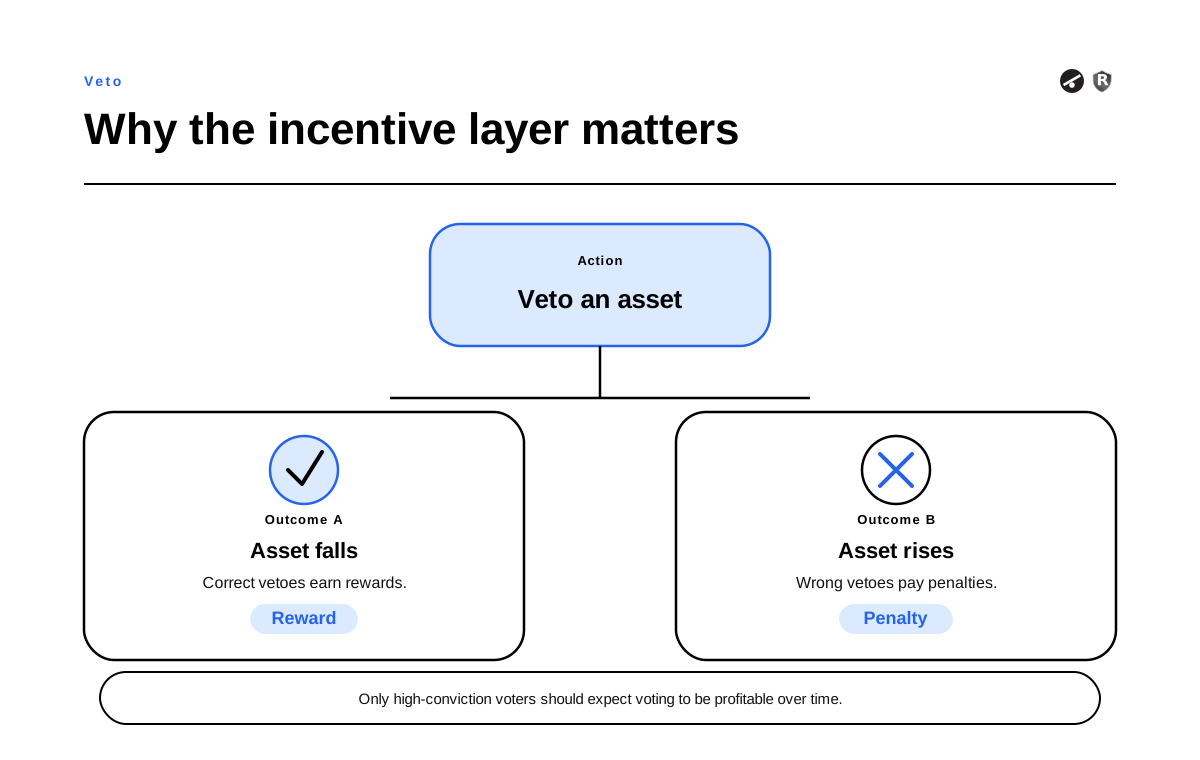
If a voter vetoes an asset and that asset falls
The voter was directionally correct.
They are rewarded.
If a voter vetoes an asset and that asset rises
The voter was directionally wrong.
They are penalized.
If a user does not vote
They do not earn rewards and do not pay direct penalties. They simply live with the portfolio outcome as a RAC holder.
What “Correct” Means
The system is forward-looking.
Votes cast in window t affect the basket for window t+1.
The voter is then judged based on how the asset performs during that next active window, not based on what already happened before the vote.
This matters.
The mechanism is designed to reward prediction, not reaction.
A voter should profit for identifying risk before the market fully prices it in, not for pointing at a move that already happened.
Reward and Penalty Logic
At a high level, payouts scale with three things:
- the size of the asset in the proposed basket
- the realized move in that asset during the settlement window
- the voter’s escrowed RAC exposure
That means:
- vetoing a large asset matters more than vetoing a tiny one
- being right on a major drawdown matters more than being right on a small move
- voters with more skin in the game have larger economic consequences
This keeps the system aligned with actual portfolio impact.
Why Rewards and Penalties Both Matter
RAC already has a natural incentive built in:
voters hold the asset they govern.
If a voter correctly vetoes a dangerous asset, they protect their own RAC holdings from that exposure.
But that alone is not enough.
Without explicit penalties and rewards:
- wrong vetoes are not punished hard enough
- correct vetoes are not compensated enough
- low-conviction participants can still generate noise
- governance becomes too easy to spam
The reward and penalty layer turns voting into a high-signal activity rather than a free opinion market.
Informational Filtering
The mechanism is deliberately asymmetric.
Incorrect voters should lose more than correct voters gain on a like-for-like basis.
In the formal model, this is expressed by choosing parameters such that:
beta > alpha > 1
This does three things:
beta > alphafilters out low-skill or random votersbeta > 1ensures wrong voters lose even when the basket itself still performs wellalpha > 1ensures correct voters are compensated even if quorum fails and the basket still takes the loss
That structure is one of the core ideas in the veto design.
It ensures that participation is economically attractive only for people with genuine conviction and edge.
Profit Threshold
The formal paper derives a simple threshold for profitable participation.
If a voter is correct with probability p, their voting becomes profitable only if:
p > beta / (alpha + beta)
This is important because it gives the mechanism an actual filtering property.
If a participant is basically guessing, they should lose money over time. If they have real forecasting ability around tail events, they should profit.
That is how the veto layer extracts information from the market.
Settlement Asset
Rewards and penalties are accounted for in USDC terms, but settled in RAC.
In practice:
- if a voter earns a reward, RAC is credited to their escrow
- if a voter owes a penalty, RAC is debited from their escrow
Using RAC as the settlement asset is important because it allows the protocol to burn excess penalties.
Global Reward Pool and Burning
The veto mechanism uses a global reward pool.
At a high level:
- penalties across all assets flow into the pool
- rewards are paid out from the pool
- if penalties exceed rewards, the surplus can be burned
- if rewards exceed penalties, the shortfall can be covered by protocol revenue
Burning matters because it recaptures value for RAC holders.
If governance participants are systematically wrong, their penalties do not just disappear. They can reduce RAC supply, increasing the value of the remaining token base.
This turns bad governance from a pure cost into a partially self-correcting system.
Why Non-Voters Still Matter
Non-voters do not receive direct rewards or penalties, but they are still economically exposed because they hold RAC.
That means the system naturally encourages two behaviors:
- informed holders can participate and be compensated for high-quality judgment
- uninformed holders can abstain and avoid direct penalties
The mechanism does not force everyone to vote. It rewards useful participation and makes low-quality participation expensive.
What Happens If Quorum Fails?
Quorum failure is an important edge case.
If a voter correctly vetoes an asset but the veto does not reach quorum:
- the asset remains in the basket
- the voter still suffers indirect RAC exposure
- but the reward structure is designed so correct minority voters can still come out ahead
If a voter incorrectly vetoes an asset and quorum fails:
- the basket may still perform well because the asset stayed in
- but the voter is still penalized
- the penalty is designed to dominate their indirect benefit
This is why the paper insists on both alpha > 1 and beta > 1.
The incentive mechanism must dominate the basket outcome when individual opinion and collective outcome diverge.
Operational Safeguards
The formal design includes several practical guardrails:
- escrow-based voting power
- snapshot-based quorum
- time-bounded voting windows
- no same-window in-and-out voting
- delegation controls
- solvency constraints on penalty scaling
- protocol-level handling for reward shortfalls
- future flexibility around adaptive quorum and partial vetoes
These safeguards exist to keep the system economically enforceable, not just theoretically elegant.
Scope of the Veto System
The veto contract does not handle trade execution.
Its role is narrower:
- receive proposed weights
- collect veto votes
- determine final weights
- pass final weights to RAC
- settle voter rewards and penalties
Execution itself belongs to the RAC protocol and related settlement infrastructure.
That separation is intentional.
The veto system governs what the portfolio should be. The execution layer governs how the portfolio is implemented.
Summary
RAC’s veto system is a democratic risk filter layered on top of an algorithmic portfolio engine.
It exists because data is powerful, but incomplete.
The algorithm is responsible for systematic optimization. The veto layer is responsible for identifying exceptional risk that historical models may miss.
The mechanism works because it ties governance to real economic exposure:
- voting power comes from escrowed RAC
- successful vetoes remove assets and redirect weight to USDC
- correct voters are rewarded
- incorrect voters are penalized
- surplus penalties can be burned to benefit RAC holders
- delegation allows expertise to scale without breaking accountability
The goal is not governance for its own sake.
The goal is to protect RAC holders by making human judgment economically useful exactly where the algorithm is most vulnerable.